
As artificial intelligence moves into robots, vehicles and industrial machinery, Europe's semiconductor manufacturers are betting that their expertise in electronics and industrial systems will become increasingly valuable.
Artificial intelligence has become synonymous with a handful of companies. Nvidia supplies the computing infrastructure, American technology companies develop increasingly capable models, and data centres provide the enormous computational resources needed to run them. But as AI begins moving beyond computers and into the physical world, another part of the technology industry is becoming increasingly important.
Robots, autonomous machines and intelligent industrial equipment cannot operate on artificial intelligence alone. They need sensors to understand their surroundings, processors to interpret information, microcontrollers to coordinate operations and power electronics to control physical movement. Much of this technology already exists within Europe's established semiconductor industry. The question is whether companies that have spent decades supplying the automotive and industrial sectors can turn those capabilities into a competitive advantage in the emerging market for physical AI.
The next AI opportunity is happening outside the data centre
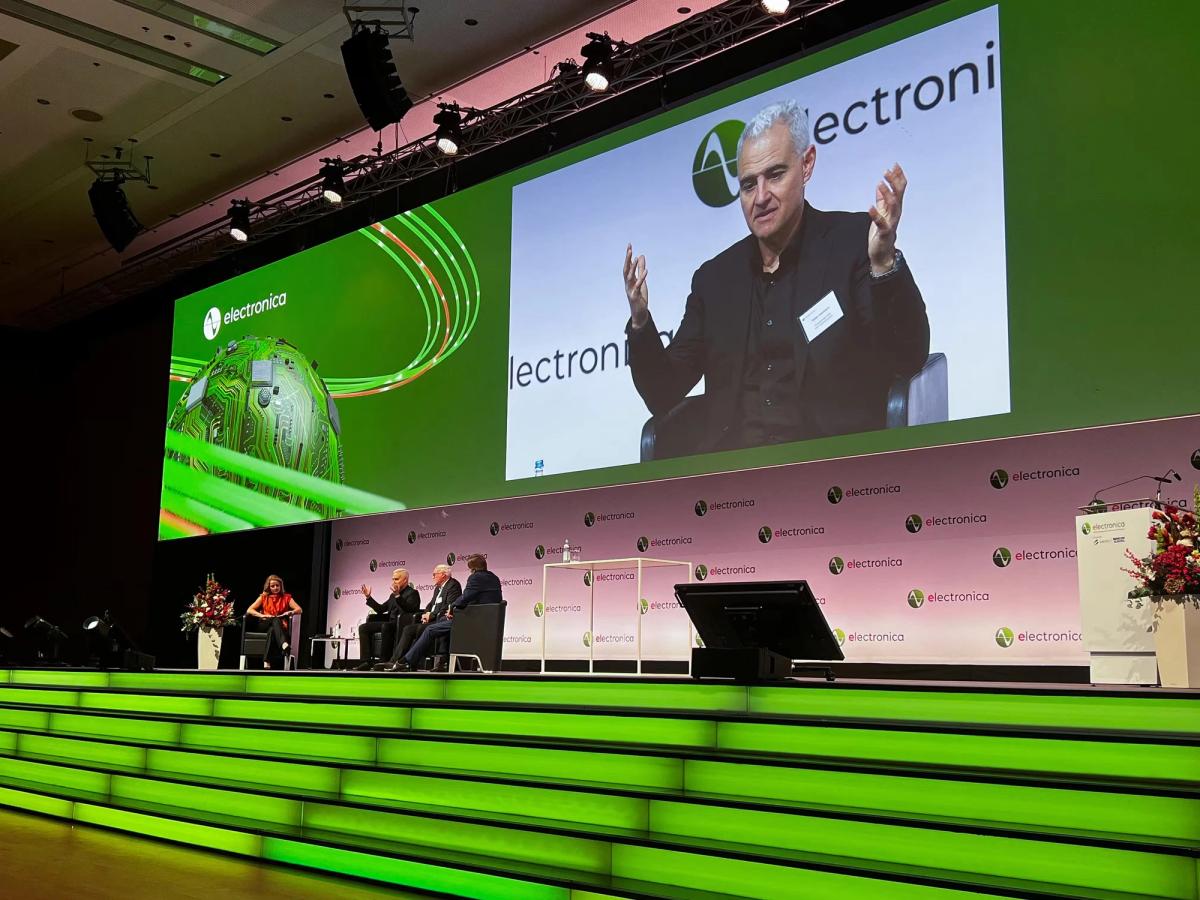
On November 10, the chief executives of Infineon Technologies, STMicroelectronics and NXP Semiconductors argued that Europe was well positioned to compete with the United States and Asia in robotics and physical AI. Their argument rests on an established industrial foundation. All three companies supply semiconductor components used in automotive electronics, industrial automation and other systems that must operate reliably in demanding environments.
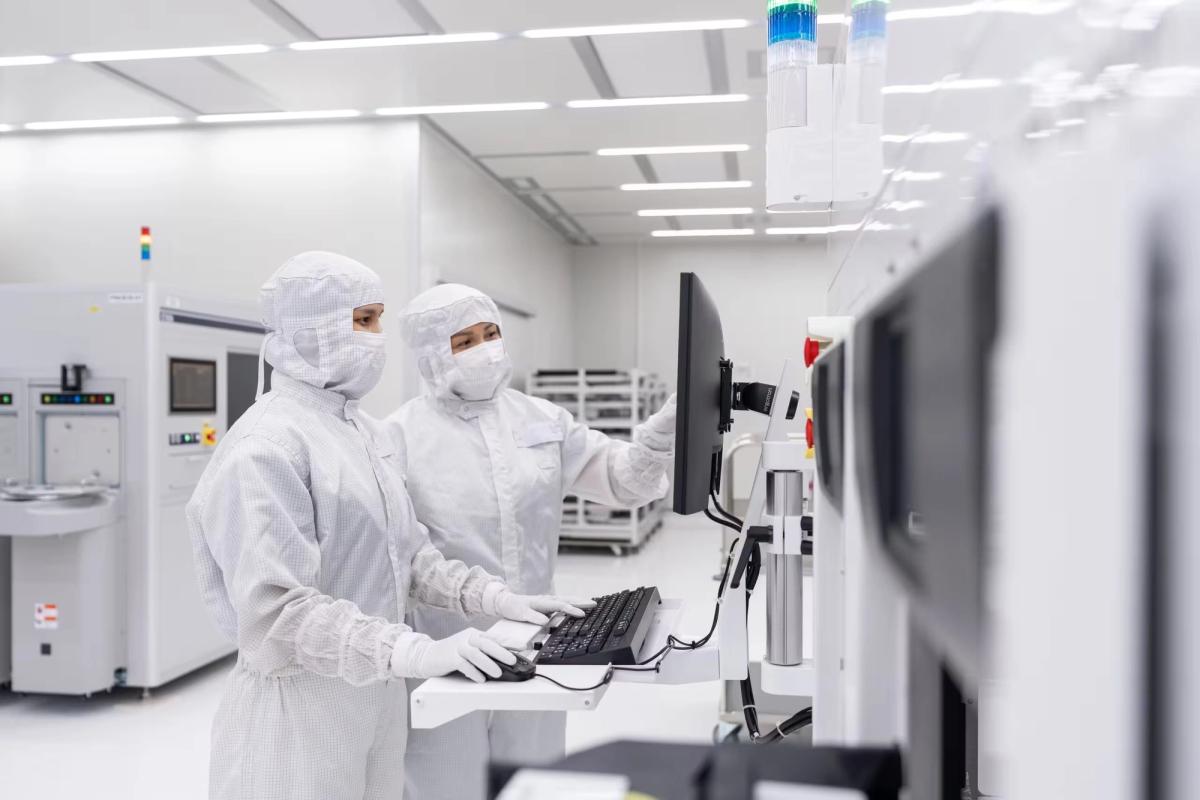
STMicroelectronics has already taken a step in this direction. The company has agreed to introduce humanoid robots developed by Italian robotics manufacturer Oversonic into its factories. The first installation has taken place at a semiconductor manufacturing facility in Malta. There is an important qualification, however. These deployments remain experimental, with factory trials considerably more common than widespread commercial adoption. The announcement is evidence of industrial interest, not proof that humanoid robots are ready to transform manufacturing.
Nevertheless, it illustrates a broader transition.
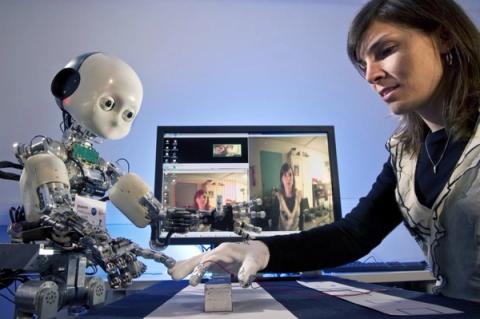
Physical AI describes systems that combine artificial intelligence with sensing, computing and physical mechanisms to perceive their surroundings and act within them. Unlike a conventional industrial robot following a fixed sequence of programmed movements, an AI-enabled machine can potentially interpret changing conditions and adapt its behaviour.
This distinction matters because conventional automation is already widespread. The emerging opportunity lies in making machines more adaptable, particularly in environments where every possible situation cannot be anticipated and programmed in advance.
Intelligence requires considerably more than a powerful processor
The popular understanding of AI often places the computational model at the centre of everything. In physical systems, intelligence is distributed across several interacting layers of technology. Consider a mobile industrial robot navigating a factory. It needs cameras, depth sensors or other sensing equipment to interpret its environment. Its computing hardware must process this information, while embedded controllers coordinate motors, communication interfaces and other electronic subsystems.
Power-management components regulate the electrical energy supplied to these systems. Motor-control electronics translate instructions into controlled physical movement. Embedded software coordinates the entire operation, ensuring that the machine responds appropriately to its environment. These components perform different functions and often operate under very different computational requirements.
A high-performance processor might run perception or AI inference workloads, while a microcontroller handles time-sensitive control tasks. The distinction is important: a machine cannot afford to wait for a complex AI model to decide whether a motor should respond to a safety-critical control signal. This is where embedded computing becomes particularly relevant. Rather than sending every operation to a remote data centre, systems can process information locally, closer to the sensors and actuators that interact with the physical environment.
Local processing can reduce communication delays, improve responsiveness and allow machines to continue performing essential functions even when network connectivity is unavailable. Research is also exploring ways to integrate computation more closely with sensing and physical hardware. In April 2026, the US Defense Advanced Research Projects Agency highlighted experimental approaches to combining sensing, adaptation and action within robotic materials themselves. The work illustrates how much further the relationship between computing and physical systems could develop.
The implication is that physical AI will not be defined by processors alone. It will depend on the integration of electronics, firmware, mechanical systems and software.
Why European semiconductor companies see an opportunity
Infineon, STMicroelectronics and NXP occupy an interesting position in this emerging market. Their businesses are already closely connected to industries where electronic systems must operate reliably over long periods, often under demanding environmental and operational conditions. Automotive electronics, for example, involves sophisticated combinations of microcontrollers, power semiconductors, sensors, communication systems and safety-related computing. Industrial equipment presents similar requirements.
These capabilities are relevant to robotics because many of the underlying engineering problems are shared. A robotic machine needs to control electric motors, distribute power, interpret sensor data and coordinate multiple electronic subsystems. Developing those capabilities requires expertise that semiconductor companies have accumulated through years of supplying vehicles, manufacturing equipment and industrial infrastructure.
STMicroelectronics has also been pursuing partnerships around physical AI. In March 2026, it announced collaboration with NVIDIA to integrate its sensors, microcontrollers and motor-control solutions into NVIDIA's robotics ecosystem. The initiative includes work involving sensor integration and simulation environments designed to help developers transfer trained robotic systems into real-world applications.
This is a particularly interesting development because it illustrates how the industry is organising itself. Companies specialising in different parts of the technology stack are working together rather than attempting to build every component independently. Europe's opportunity, therefore, may lie in becoming an important supplier of the underlying hardware and engineering systems that make intelligent machines commercially viable.
That does not mean European companies are automatically positioned to dominate the market. Competition from American and Asian semiconductor manufacturers remains substantial, while Europe's dependence on foreign suppliers for certain advanced semiconductor technologies remains a strategic weakness.
The European Commission's June 2026 proposal for a second Chips Act explicitly acknowledges these dependencies and seeks to strengthen the region's position across both mainstream and advanced semiconductor technologies.

The industrial reality is more complicated than the robotics demonstrations
Humanoid robots attract attention because they resemble people and appear capable of performing a wide variety of tasks. But their visual appeal can distract from a more important question: where can intelligent machines deliver measurable economic value? In many industrial environments, a machine does not need to resemble a human being. It needs to perform a specific task reliably, safely and at a competitive cost.
Autonomous warehouse equipment, intelligent inspection systems, adaptive manufacturing machinery and specialised robotic arms may offer more immediate commercial opportunities than general-purpose humanoid robots. The challenge is that moving from a demonstration to dependable industrial deployment is considerably harder than developing a machine that can perform an impressive sequence of actions.
Factories are unpredictable environments. Objects change position, equipment wears down, lighting conditions vary and unexpected situations occur. A robot must recognise when conditions differ from what it has encountered before and respond without creating unacceptable risks. Simulation can help train robotic systems across a wider range of scenarios, but the transition from simulated environments to physical operation remains difficult. Real-world friction, sensor inaccuracies, mechanical variation and unpredictable interactions can produce behaviour that simulations do not fully capture.
Safety introduces another layer of complexity. An incorrect response from a chatbot might produce misleading information. An incorrect command from a machine can damage equipment, interrupt production or endanger people. Consequently, intelligent industrial systems must combine AI capabilities with dependable control architectures, monitoring, protective mechanisms and carefully designed operating limits. These requirements are not peripheral engineering considerations. They are central to whether physical AI can become commercially useful.
The semiconductor opportunity has its own supply-chain problem
There is another complication emerging at precisely the moment European chipmakers are discussing the opportunity. In a separate report on November 10, Reuters highlighted concerns that the growing demand for AI infrastructure is putting pressure on semiconductor supplies for traditional industries.Nexperia's interim chief executive warned that manufacturers were redirecting capacity towards higher-margin AI data-centre products, contributing to bottlenecks in the supply of mature semiconductor technologies used in vehicles and industrial equipment.
STMicroelectronics' chief executive also raised concerns about foundries and packaging companies shifting resources away from automotive and industrial products. This creates an interesting contradiction. The expansion of AI could increase demand for the very components that European semiconductor manufacturers specialise in, while simultaneously making some of those components more difficult to manufacture and source.
It also demonstrates why semiconductor competitiveness cannot be measured exclusively through the performance of the most advanced processors. Diodes, transistors, microcontrollers and power-management components may not attract the same attention as high-performance AI accelerators, but they remain essential to the operation of increasingly sophisticated electronic systems.
Europe's ambitions in physical AI will therefore depend partly on its ability to maintain and expand the manufacturing capacity supporting these technologies. The European semiconductor industry has a credible opportunity here. Its experience in automotive and industrial electronics gives it capabilities that are directly relevant to the next generation of intelligent machines. But the transition from supplying individual components to participating in a rapidly expanding robotics ecosystem will require continued investment, collaboration and successful commercial deployments.
The next phase of artificial intelligence may be remembered for machines that can perceive, decide and act. Whether those machines become economically viable will depend on an enormous amount of engineering happening beneath the surface.
And much of that engineering begins with the semiconductor.


Discussion
Join the discussion
Comments are hosted by GitHub Discussions. You will need a GitHub account to take part.