

For years, our collective anxiety about artificial intelligence has been shaped by a theology of disembodiment. We imagine a silicon consciousness arriving like a weather front; formless, weightless, and infinitely scalable, sweeping across the digital landscape to render human thought obsolete. In this standard apocalyptic script, the battle lines are drawn in the ether. We picture algorithms dueling with poets, neural networks out-writing journalists, and large language models absorbing the accumulated corpus of human expression until we are left as redundant spectators in our own intellectual history.
This framing is intellectually convenient, but it is fundamentally mistaken. It treats intelligence as if it were an atmospheric pressure system, entirely detached from the heavy, stubborn architecture of the material world.
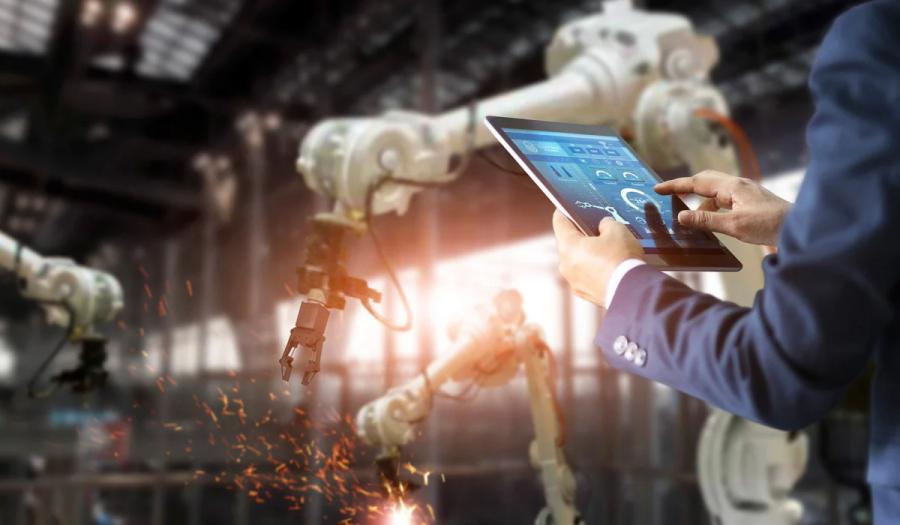
When we look exclusively at screens, text boxes, and server clusters, we miss the actual trajectory of modern technology. The most consequential frontier of computation is not cyberspace. It is the factory floor, the electrical substation, the automated port, and the embedded microcontroller running on a 3.3-volt rail inside a sealed industrial enclosure. Intelligence does not exist in a vacuum; it requires electricity, thermal management, rare-earth metals, copper busbars, and physical actuators to exert any force upon reality.
When we ask who commands the future, the answer will not be decided by software benchmarks or philosophical debates about artificial general intelligence. It will be decided by who controls the physical substrate that allows code to touch matter.
The Illusion of Pure Scale
The myth of disembodied software is a byproduct of the internet era. For two decades, the dominant technology companies built empires on marginal costs near zero. To scale a social network, a search engine, or a document repository, you merely had to replicate bits across distributed data centers. Software felt weightless because its physical anchors were safely tucked away in windowless warehouses out in suburban industrial parks, humming quietly behind concrete walls and heavy security gates.
This created a cultural hallucination: the belief that humanity was migrating upward into a pure, frictionless digital realm.
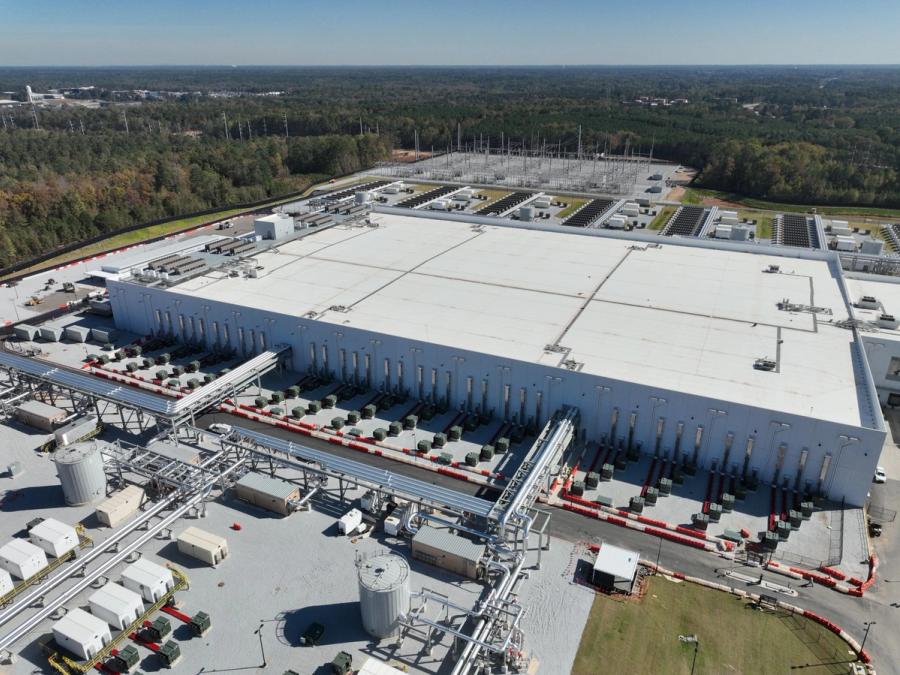
But artificial intelligence is changing the rules of this migration by demanding staggering quantities of physical resources. A modern training cluster is a massive industrial plant requiring dedicated high-voltage power lines, millions of liters of cooling water, thousands of tons of structural steel, and specialized semiconductors forged in ultra-clean manufacturing facilities that represent the absolute pinnacle of human industrial capability.
More importantly, once trained, an intelligence that cannot act upon the physical world remains trapped in a cage of pure contemplation. An LLM can write an exquisite maintenance manual, diagnose a complex thermodynamic failure, or generate millions of lines of control firmware, but it cannot tighten a loose flange, replace a blown fuse on a transformer, or weld a structural seam.
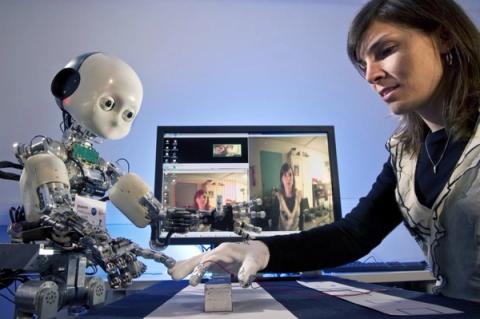
To bridge the gap between thought and action, computation must descend from the server rack into the machine. And that descent reveals a stark reality: the world is made of atoms, and atoms do not scale the way bits do.
The Silent Convergences
If you walk through a modern automated manufacturing plant or inspect the control architecture of a contemporary electrical grid, you do not see science-fiction androids walking the aisles. You see something far more subtle and pervasive: the silent convergence of machine learning with embedded systems, industrial protocols, and sensor arrays.
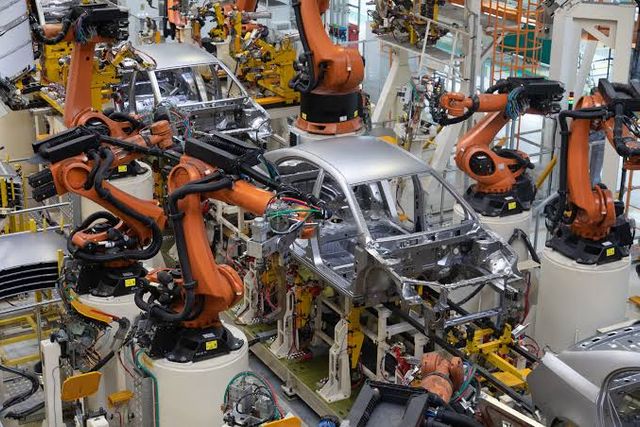
Consider what is happening beneath the surface of industrial automation. For decades, factories operated on rigid, deterministic logic; Programmable Logic Controllers (PLCs) executing strict, hard-coded ladder logic. If a sensor drifted out of calibration or a mechanical arm encountered an unexpected vibration pattern, the system either halted or faulted out, waiting for a human technician to intervene.
Today, that boundary is dissolving. Microcontrollers sitting at the edge; small, power-efficient silicon chips running on local boards, are now capable of running lightweight neural networks that monitor motor vibration, predict bearing failure weeks before it happens, and dynamically adjust hydraulic pressures in real time.
This is not the glamorous world of generative AI writing poetry. This is the unglamorous, high-stakes world of predictive maintenance, closed-loop feedback systems, and low-latency motor control. It is happening in automotive stamping plants, water treatment facilities, logistics hubs, and agricultural irrigation grids.
The significance of this shift is profound. When intelligence is embedded directly into machinery, the machine ceases to be a dumb tool executing repetitive instructions. It becomes an autonomous agent operating under physical constraints. But unlike a chatbot, which can hallucinate a paragraph with zero real-world consequence, an embedded system making a control decision in a physical environment carries immediate, catastrophic costs if it fails. A bad line of code in an enterprise software suite results in an error message; a miscalculated torque command in an industrial robotic arm results in a shattered casting, a damaged assembly line, or a workplace injury.
This is why the coming technological conflict will not be fought over digital real estate. It will be fought over the ownership, maintenance, and security of the physical infrastructure layer where computation meets physical force.
The Energy Bottleneck and the Grid
You cannot talk about the convergence of AI and matter without confronting the most urgent physical constraint of our century: energy.
For the past fifteen years, the tech sector operated in an era of cheap, abundant electricity, treating power as an infinite background utility. Data centers could expand silently, drawing megawatts from regional grids without public friction. That era has abruptly closed. The computational density required for modern model training and edge inference has turned server farms into heavy industrial power consumers that rival aluminum smelters and steel mills.
This creates an immediate geopolitical and economic bottleneck. AI companies are now forced to become energy developers. We see major technology firms investing in nuclear power restart projects, negotiating direct power purchase agreements with hydroelectric utilities, and installing localized microgrids powered by natural gas and solar arrays.
The physical world is pushing back against digital expansion. When a data center consumes as much electricity as a medium-sized city, it enters direct competition with residential neighborhoods, manufacturing plants, and municipal services.
Herein lies the hidden fault line. Electrical grids are ancient, aging systems of copper, aluminum, transformers, and switchgear designed for a twentieth-century industrial economy, not a twenty-first-century computational empire. Modernizing a transmission grid requires digging trenches, stringing high-voltage lines through populated corridors, manufacturing massive power transformers with multi-year production backlogs, and navigating complex regulatory jurisdictions.
An algorithm can generate a million lines of optimization code in seconds, but it cannot manufacture a single amorphous steel core for a high-voltage transformer. The physical inertia of industrial manufacturing acts as an absolute brake on digital acceleration. Those who control the physical supply chains of power generation and grid hardware hold an unassailable veto over the expansion of intelligence.
The Re-Enchantment of the Physical
There is a strange irony in our current technological moment. For thirty years, we were told that the future belonged to the virtual; that physical objects would dissolve into software, that remote work would empty our cities, and that tangible manufacturing would become a secondary concern compared to intellectual property and digital services.
Instead, reality has reasserted itself with terrifying force.
We are discovering that you cannot decouple the digital mind from the physical body of civilization. Every breakthrough in artificial intelligence relies entirely on the extraction of physical minerals; lithium, cobalt, copper, silicon, neodymium, refined in high-heat furnaces, transported in diesel-powered cargo ships, assembled by precision robotics, and powered by massive thermal and nuclear generators.
When we frame the future as a battle between humans and AI, we are treating ourselves as mere intellects competing in an abstract cognitive arena. But humans are not disembodied minds. We are physical beings who inhabit a material world built of concrete, steel, wiring, and soil.
The real contest of our time is not about whether a machine can write a better essay than a university student. It is about who manages, repairs, feeds, and commands the physical infrastructure that sustains both human life and machine intelligence.
If you own the servers, but you do not own the electrical substations, your intelligence is at the mercy of the grid operator. If you control the algorithms, but you do not control the fabrication plants that etch the silicon wafers, your software is a ghost without a host. If you optimize the logistics chain, but you do not maintain the physical ports, highways, and container ships, your supply network is vulnerable to the first physical shock that hits the system.
The Work That Cannot Be Virtualized
As we look toward the horizon, the prestige economy is due for a profound inversion. For decades, status and capital flowed away from the physical world and toward the pure digital stratum; software engineering, financial engineering, brand management, and abstract digital creation.
The coming decades will likely reward a different kind of competence entirely. The engineer who understands how to interface a neural network with a high-torque brushless motor; the technician who can diagnose a fault in an industrial automation bus; the metallurgist who can improve the thermal tolerance of turbine blades; the energy planner who can balance a localized microgrid, these are the people who stand at the fulcrum of the new economy.
They are not competing with AI. They are the translators between the disembodied logic of computation and the stubborn, unyielding reality of matter.
The coming battle is not humans versus machines in some cinematic struggle for planetary dominance. It is a much more pragmatic, structural negotiation over how we anchor intelligence into the physical world without breaking the systems that sustain us.
When the dust settles on the current wave of technological hype, we will find that the future does not belong to the purest code or the most sophisticated neural network. It belongs to those who understand that every byte requires an atom, every algorithm requires an ampere, and every digital leap must ultimately pay rent to the physical laws of the universe.

Discussion
Join the discussion
Comments are hosted by GitHub Discussions. You will need a GitHub account to take part.